You know that nagging feeling when you’re somewhere on hour three of your return flight, squeezed between a snoring stranger and a very chatty toddler, and suddenly your brain decides right then is the perfect time to wonder if you’ll actually remember where you parked? That low-grade panic that starts somewhere in your chest and spreads outward isn’t just in your head. Well, technically it is in your head, but it’s also completely valid.
The Science Behind Parking Lot Panic
Our brains weren’t designed for the modern world of massive parking facilities. For thousands of years, humans relied on spatial memory tied to distinctive landmarks and familiar environments. Drop someone in a sea of identical parking spaces under fluorescent lighting, add the stress of catching a flight, and you’ve basically created the perfect recipe for memory failure.
Research in cognitive psychology shows that stress hormones actually interfere with memory formation. When you’re rushing to catch your flight, worried about TSA lines, mentally reviewing your packing list, and trying to remember if you turned off the coffee maker, your brain isn’t prioritizing which row you parked in. It’s in survival mode, and frankly, parking space location doesn’t register as survival-critical information.
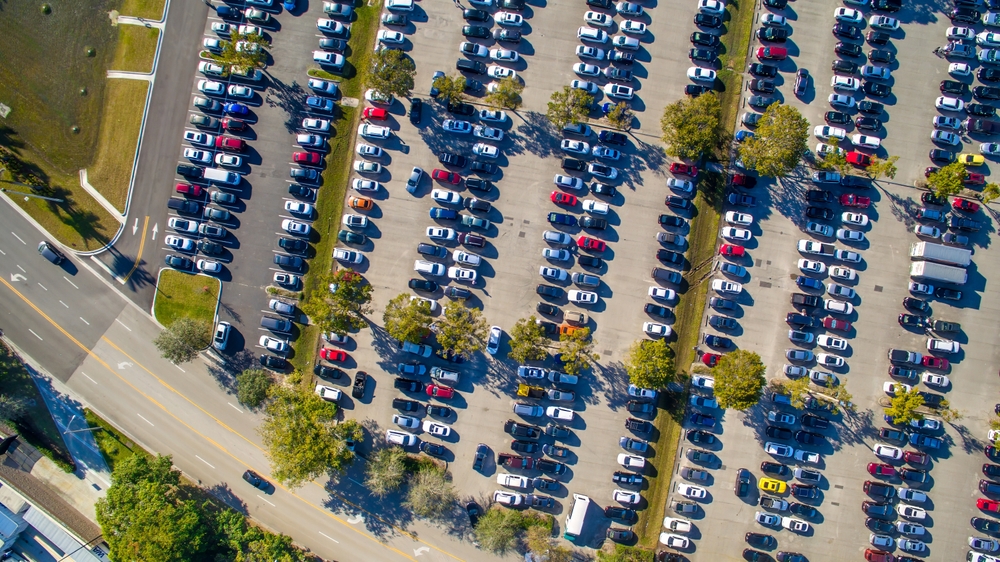
The parking lot environment itself works against you. Most facilities are deliberately designed for efficiency, not memorability. Rows look identical. Lighting is uniform. The concrete all matches. Your brain struggles to create the distinctive mental anchors it needs to form solid memories.
Why We Forget Where We Parked
Memory formation requires attention, and attention is a limited resource. When you’re parking before a trip, your mind is typically occupied with about seventeen other things. The actual act of parking becomes what psychologists call an “automatic behavior,” something you do without conscious thought. And what doesn’t get conscious attention rarely makes it into long-term memory.
Common mental distractions during pre-flight parking:
- Flight time concerns and schedule anxiety
- Luggage inventory and gate information
- Travel documents and ID verification worries
- Weather at your destination
- Work or family obligations you’re leaving behind
Add to this the fact that you might not return to that parking spot at Philadelphia Airport for days or even weeks. Your brain has processed thousands of other visual experiences in the meantime. That mental image of your parking location has been buried under layers of new memories, making retrieval even harder.
Time distortion plays a role too. The few minutes you spend parking your car before a trip feel rushed and compressed. But the journey back, after a long flight when you’re tired, feels endless. This temporal asymmetry makes the parking experience feel like it happened in a different lifetime.
The Emotional Weight of Vehicle Anxiety
Lost in a parking lot, you’re not just geographically confused. You’re emotionally compromised. There’s embarrassment (what kind of adult can’t find their own car?), frustration (I just want to go home), and genuine worry (what if someone stole it and that’s why I can’t find it?).
For many travelers, their vehicle represents security. It’s familiar territory in an unfamiliar process. The car is what takes you home after your journey. Not being able to locate it triggers a primal anxiety about being stranded.
Solo travelers often experience this more intensely. Without a travel companion to share the cognitive load of remembering logistics, the entire burden of spatial memory falls on one person. Women traveling alone may feel additional vulnerability when searching parking lots late at night.
How Different Parking Layouts Affect Memory
Not all parking facilities are created equal, and their design significantly impacts your ability to remember your spot. Understanding these differences helps you appreciate why some parking experiences feel more stressful than others:
Parking layout memory challenges:
- Multi-level garages create the highest memory burden because vertical space is harder for brains to encode than horizontal layouts, and every level looks nearly identical
- Open lots with numbered rows offer moderate difficulty since the lack of distinctive features makes rows blend together in your memory
- Covered structures with zone systems provide some mental anchors but can still create confusion when zones lack unique characteristics
- Smaller lots with natural landmarks work best with human memory because boundaries and features give your brain something concrete to latch onto
- Valet service eliminates memory burden entirely by removing the responsibility from travelers
The worst offenders are parking facilities that use only numbers or letters for identification. “You’re in Row J, Space 47” means nothing to your brain without additional context. The information is abstract rather than visual or spatial.
Practical Solutions That Actually Work
Understanding why we forget where we parked is only helpful if we can do something about it. The good news is that several evidence-based strategies can dramatically reduce parking anxiety.
Five proven methods to remember your parking location:
- Take a photo immediately after parking. Your phone already has a timestamp and often location data embedded in the image. Bonus points if you capture a landmark or row marker in the shot.
- Create a memorable mental story. Instead of trying to remember “C4,” think “C is for coffee, and I need 4 cups after this flight.” Weird, specific, or humorous associations stick better than dry facts.
- Walk the route to the shuttle pickup and look back. This creates bidirectional memory. You’re not just remembering where you parked, but also what the path back looks like.
- Use voice notes on your phone. Speak your parking location out loud while recording. “I’m in the covered lot, purple level, third row from the elevator, blue Honda Civic.” The act of verbalizing helps encode the memory.
- Look for something unique nearby. Maybe there’s a light post with a dent, a painted curb, or a tree near your space. Distinctive features give your memory something to grab onto.
Some travelers swear by dropping a pin in their phone’s maps app. This works well if you remember to do it, though cellular service can be spotty in some parking structures.
How Jet Stream Parking Eliminates Location Anxiety
Understanding the psychology of parking stress is only valuable if there’s a practical solution. At Jet Stream Parking, we’ve built our entire system around reducing the mental burden on travelers so you can focus on your journey instead of worrying about finding your car.
The cornerstone of our approach is the reminder card system. When you arrive, our shuttle drivers meet you right at your vehicle and provide you with a physical card that clearly indicates your exact parking location. This simple piece of card stock becomes your backup memory, tucked safely in your wallet next to your ID throughout your trip. No apps to download, no pins to drop, no memory tricks required.
Our facility design works with your brain rather than against it. Both our covered structure and open-air lot feature clear signage and ample lighting that creates visual landmarks. You’re not navigating a confusing maze of identical concrete levels. The layout is intuitive, and the environment feels secure, which reduces the baseline stress that interferes with memory formation in the first place.
The Return Journey Made Simple
When you land and collect your luggage, the last thing you want is to wander around a parking lot clicking your key fob. Our shuttle service eliminates that anxiety completely. Simply call our team, let them know you’ve returned, and our drivers will pick you up from the terminal.
Here’s where the reminder card proves its worth. You reference your parking location, share it with the driver, and they take you directly to your vehicle. No guessing, no searching, no stress. Our drivers even help with luggage unloading, so you can get on the road and head home without any additional hassle.
This system creates redundant safety nets for your memory. You have the physical card. You have helpful staff who know the facility. You have a shuttle that drops you at your exact spot rather than a general area. Each layer reduces anxiety and ensures that even on your most exhausted, brain-fogged return, you’ll get back to your car quickly and easily.
Why Location Reminders Matter More Than You Think
That simple reminder card might seem like a minor amenity, but it addresses one of the most common pain points in the airport parking experience. Psychology research confirms that external memory aids are incredibly effective. They free up mental resources for other tasks and eliminate the low-level background anxiety of trying not to forget important information.
Some travelers photograph their reminder card as an additional backup. Others set a reminder on their phone: “Retrieve parking info from wallet before leaving airport.” The specific method matters less than having a reliable system.
Modern technology has helped too. Some parking apps let you save your spot digitally, send you reminders, and even guide you back to your vehicle. But these solutions only work if the parking facility has implemented the technology and you’ve downloaded the app before parking.
The Simple Elegance of a Good System
At its core, parking anxiety stems from uncertainty. You’re uncertain if you’ll remember where you left your car. You’re uncertain how long it will take to find it when you’re tired and ready to be home. You’re uncertain if you’ll look foolish wandering around clicking your key fob.
The solution isn’t just physical infrastructure or technology. It’s a combination of smart facility design, helpful staff, and simple systems that align with how human memory actually functions. When a parking service understands the psychology behind location anxiety and builds solutions directly into their process, everybody benefits.
Good short-term airport parking at the Philadelphia Airport or beyond should be forgettable in the best way. Not because you forgot where you parked, but because the system was so smooth you didn’t have to stress about it in the first place.
Take the Stress Out of Your Next Trip
Location anxiety doesn’t have to be part of your travel experience. At Jet Stream Parking, our reminder card system, attentive shuttle drivers, and well-designed facility take the guesswork out of parking. Book your reservation today and experience airport parking designed around how travelers actually think and feel.